68948d2818a72.png)
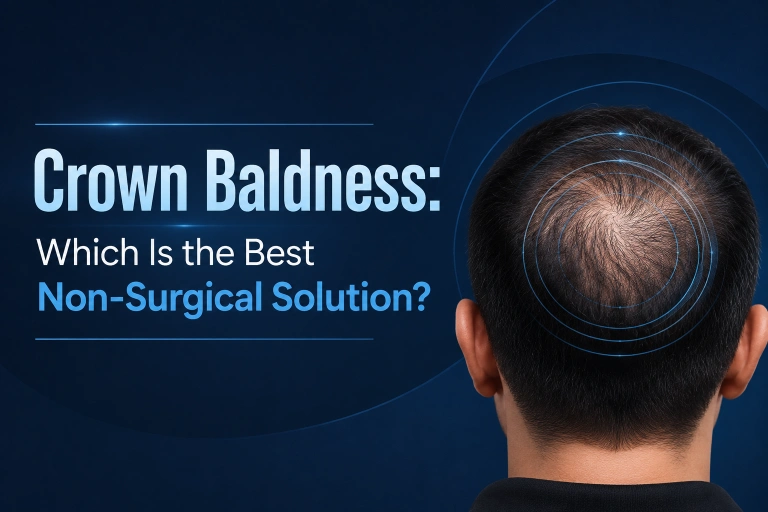
Crown Baldness: Which Is the Best Non-Surgical Solution?
Posted Date : August 17, 2026
Losing hair at the top of your head feels different from losing it at the sides. It happens quietly, in a place you don't often look at directly, until a photo or a new angle in the mirror reveals what's been going on for months. For early crown thinning, treatment support may help slow the loss. For visible crown baldness, a customised non-surgical hair system is often the most practical solution for immediate, natural-looking coverage.
In this blog, we discuss what causes crown baldness, how to spot early thinning at the crown, and which non-surgical solutions can help you manage hair loss with the right professional guidance.
What Is Crown Baldness?
The term refers to hair thinning that starts at the vertex, the topmost point of your scalp, rather than at the temples or frontal hairline. Vertex thinning is different from a receding hairline because it happens toward the back of the head, where it’s less visible and more likely to be ignored.
The most common cause is androgenetic alopecia, which is often associated with DHT, a hormone derivative that can gradually miniaturise follicles in the crown area over time. The Norwood Scale is used by dermatologists to chart progression, and starting at stage 3 Vertex, a distinct circular patch is usually seen. The earlier the action, the more options are available
Early Signs of Crown Thinning
Most people do not notice crown thinning until it has been progressing for a year or more. Because the area is out of view, you can easily miss small changes. Catching the signs before the thinning becomes obvious gives you more time, more options, and a better chance of a result that feels natural rather than reactive.
Here is what to watch for before it becomes harder to address.
- A visible circle of scalp at the top of your head, most obvious under bright overhead lighting.
- Hair at the crown lies noticeably flatter, even after you style it
- More time is needed to achieve the same look as volume quietly reduces.
- Increased shedding is noticeable on your pillow or after washing, with the shedding concentrated at the crown.
- Aerial photography shows an increasing area that cannot be seen from the front.
If thinning is progressing quickly or appearing in irregular patches, seeing a dermatologist or trichologist before starting any treatment is the safer approach.
Non-Surgical Treatment Options
Today, there are more choices available than most people realise. They all function in their own way, depending on your stage of loss, scalp condition and overall health. Some may focus on targeting the cause of thinning, while others focus on restoring the appearance more directly. Knowing what each option entails will help you to be better informed when you talk to a professional before making a decision.
- Minoxidil (oral or topical): When taken orally or applied topically, it can increase blood flow around the hair follicles, thereby promoting growth, and has been shown to have a positive effect in early- to mid-stage hair loss under the guidance of a medical professional.
- Finasteride and alternatives: Oral medications that can reduce DHT at the source, requiring ongoing use and professional supervision.
- Low-level laser therapy: Specific wavelengths of light may stimulate follicle metabolism, with visible changes often reported after about 6 months of consistent use.
- PRP therapy: Uses a concentration of your platelets to support follicle activity and generally works best when some follicle function remains.
- Scalp micropigmentation: Uses pigment to replicate the appearance of follicles, best suited to those preferring a closely cropped look.
- Growth serums and supplements: May help address deficiencies in iron, vitamin D, and B12 often associated with increased shedding.
Which Treatment Works Best
There is no one solution that fits all of the requirements for crown loss. The stage your thinning has reached, your personal health history, and how quickly you want a visible result all shape what is appropriate. Some treatments take months to show any change, while others deliver coverage immediately.
If you know where you are on the scale, it makes the decision much clearer.
- Stages 2 to 3: Many dermatologists may recommend minoxidil, finasteride, or a combination approach for suitable early-stage cases.
- Stages 4 to 5: PRP alongside topical treatment may extend the viable window before a system-based solution becomes more practical.
- Stages 6 and above:At this point, follicle activity is usually too low for growth treatments to work. Hair fixing and scalp micropigmentation both provide coverage without surgery. .
- Results timeline: Most treatments may require 3 to 6 months to stabilise, with visible changes typically appearing between 6 and 12 months.
- For immediate coverage at any stage, a custom non-surgical hair system remains one of the fastest-acting options available.
Lifestyle Factors That Affect Crown Hair Loss
Clinical treatment works better when your daily habits support it rather than undermine it. Diet, scalp care, and stress management each play a role in how your follicles respond to any treatment you follow. These are not replacements for professional care, but ignoring them consistently can slow down even a well-chosen treatment plan. When you make small changes alongside clinical support, you often see significant improvements in outcomes.
- Protein and iron intake directly support hair production, and deficiencies are often associated with increased shedding.
- Scalp hygiene matters more than most realise, as buildup around follicle openings can work against treatment progress over time.
- Long-term stress can throw off the hair growth cycle, so it's important to manage stress as a part of a successful plan.
- Crash diets often trigger increased shedding two to three months after the event, particularly if you are already experiencing thinning.
Why Hairs Culture Is the Right Choice for Non Surgical Hair Solutions
Hairs Culture was started in 2010 with one clear belief: hair loss deserves a personal response, not a generic product. Over more than 15 years, we have worked with more than 2,000 clients across India, the UAE, and Qatar.
The biggest risk with crown thinning is treating it without professional advice. DIY products bought without a scalp assessment often target the wrong cause or stage, which wastes months you don't get back. A proper hair clinic examines your scalp and hair loss pattern before recommending anything. Without regular monitoring, it is difficult to figure out if something is working, especially in humid climates such as those across India, the UAE, and Qatar, where scalp conditions can change rapidly.
A consultation with us begins with assessment, not a sales conversation. Before we make a recommendation, we will examine your scalp condition, hair loss pattern, and your personal health. Where early-stage support may help, we guide you toward appropriate options. For visible crown loss, our hair replacement services and custom hair systems deliver a natural appearance from day one.
If you are noticing crown thinning, the clearest next step is a proper consultation. Early thinning can often still benefit from scalp-based support, with obvious crown baldness typically requiring a personalised non-surgical hair system for instant coverage. At Hairs Culture, we help you understand where you stand and what suits your stage, lifestyle, and comfort. Book your consultation today and take the first step toward a fuller, more natural-looking crown.


OUR BRANCHES
Abu Dhabi
1402-5A, Al Saman Tower A, Hamdan Bin Mohammed St, 601, Al Danah, Abu Dhabi 22208
Mob: +971 52 537 9516
Cochin
3rd Floor, Panorama House, Subash Chandra Bose road, Kadavanthra P.O, Kerala-682020, India
Mob: +91 98469 45333
Calicut
Door # 5/1539 A Krisha Arcade, Jawahar Colony Road, Ashokapuram, Calicut, Kerala-682036, India
Mob: +91 98469 45333
Quilon
1st Floor, Kailash Diabetic Centre, Aanjili Road, Quilon, Kerala-691001, India
Mob: +91 98469 45333
Thrissur
Kingsway Building, C Achutha Menon Rd, Punkunnam, Thrissur, Kerala-680020
Mob: +91 98469 45333
Qatar
Ground floor, Room 02, Ezdan Building # B-1, 4 C Ring Road, Zone:27, Street:230, Baladiya Building:78, Umm Ghuwailina, Doha, Qatar
Mob: +974 3319 5277
Trivandrum
3rd Floor, CPS Plaza,NH Bypass, Venpalavattom, P.O,Anayara, Thiruvananthapuram, Kerala 695029
Mob: +91 95443 33884


▲