68948d2818a72.png)
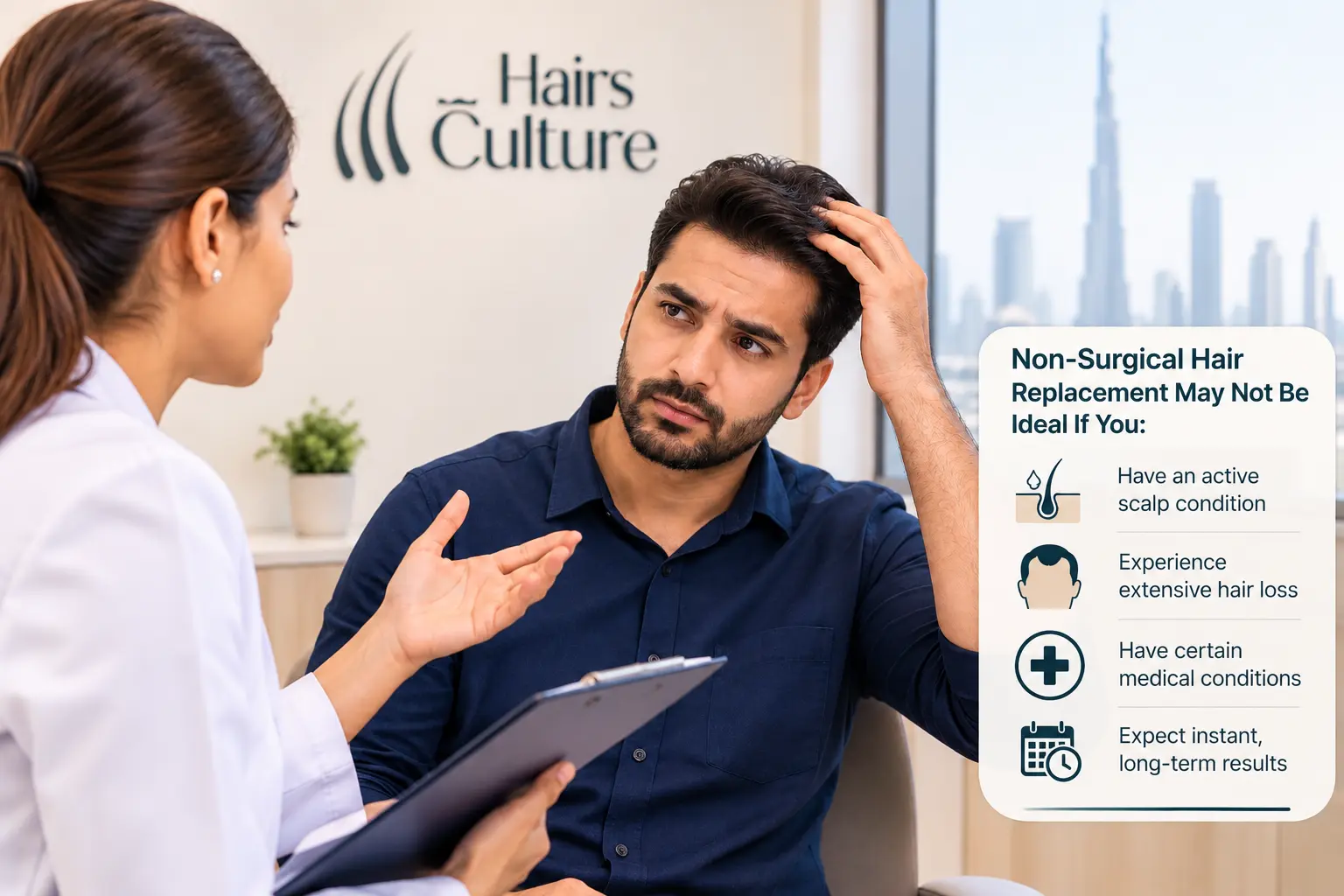
Who May Not Be an Ideal Candidate for Non-Surgical Hair Replacement
Posted Date : November 20, 2026
Who May Not Be an Ideal Candidate for Non-Surgical Hair Replacement
Hair systems are effective if you need the quick coverage of thinning or balding areas without surgery, if only the conditions are suitable. Your scalp needs to be healthy, your skin has to tolerate adhesives, you need time for regular maintenance, and your expectations should match what a system can deliver. We look at who may benefit from it, when certain scalp or skin concerns need attention, and when professional advice can help you choose the right option.
Who Can Use Non-Surgical Hair Replacement?
It suits you if thinning hair, bald patches, or lost density bother you and you want to improve the appearance of thinning or bald areas without surgery. It works best when your scalp is healthy and you are ready for regular upkeep, since a system needs care after the fitting.
- Crown thinning can be addressed with a small system that covers the thinning area and blends with the surrounding hair for a more even appearance.
- Bald patches and wider hair loss need different coverage. A single patch usually needs a small, targeted piece, while thinning across the top or sides needs a larger system for an even finish.
- Immediate appearance is the clearest advantage of a system. The change shows on the day of your fitting, so with nonsurgical hair replacement, you avoid recovery time and months of waiting for regrowth. This can be useful if you have a job or event coming up.
- Existing hair plays a part in how the system is blended and attached, so its length and density are assessed first. Scalp condition matters even more. If you notice irritation or a patch you cannot explain, have it examined before any fitting, because a healthy scalp gives the system the best base.
When is Hair Replacement Not Suitable for You?
Hair replacement may need to wait if your scalp is irritated, broken, or affected by an untreated condition. Adhesive reactions and very sensitive skin should also be cautious when using adhesives. These problems do not mean you cannot get hair replacement, but they should be assessed before fitting.
- Active irritation: This means your scalp is already showing signs of irritation. Redness, itching, burning, or swelling may worsen under a hair system, so address the underlying cause before proceeding.
- Open or damaged skin: Keep affected areas uncovered until they have healed. Cuts, sores, or broken skin may worsen under a hair system attachment.
- Unexplained scalp problems: Need checking before you choose a system. A new patch, a change in texture, or flaking that keeps returning could have a cause that decides what is safe to wear.
- Adhesive reactions: Should be mentioned at your first visit. If tapes or glues have ever given you a rash or burning, tell your specialist, as another attachment method may work.
- Sensitive skin: Can react to pressure, sweat, and product buildup, even without a past reaction.
- Ongoing discomfort: While wearing a system should not be ignored. Pain or ongoing irritation means the fit or method needs review.
- Medical concerns: Those persist or have no clear cause should be assessed by a dermatologist.
However, not being suitable right now does not mean you cannot consider hair replacement later. Once the scalp problem is treated and the skin has healed, your suitability can be reviewed again.
Does Your Lifestyle Suit a Hair System?
Most lifestyles can accommodate a hair system, but your daily routine determines how much care it needs. Exercise, swimming, heat, humidity, headwear, and travel all affect how well the system holds and how often it needs maintenance. These factors do not usually rule out wearing a system.
- Exercise and heavy sweating: can increase sweat and buildup around the system, so regular cleaning becomes more important.
- Outdoor work: in heat, dust, or strong sun, routine care is more important because the system is exposed for hours.
- Swimming: can affect how long a system stays secure and how it looks afterwards. If you swim often, ask your specialist how to care for your system before and after swimming.
- Heat and humidity: raise sweat and oil on the scalp, which affects comfort and how often you need maintenance.
- Helmets and headwear: can rub against the system and affect its hold over time. If you wear a helmet or cap every day, mention it before choosing one.
- Travel: makes scheduled appointments harder to keep, especially if you move between different climates.
- Hair care: Daily cleaning, gentle detangling, and styling suited to the system keep it looking natural, and professional maintenance visits handle what home care cannot.
What Should You Expect From Non-Surgical Hair Replacement?
A hair system changes the appearance of your hair; it does not restore natural growth or treat the underlying cause of hair loss. You should also expect regular care, maintenance, and occasional adjustments. Knowing these factors helps you decide whether the option suits you.
- Appearance depends on several details: colour, density, texture, hairline, and how the system is fitted and styled. A well-matched system looks natural, while a poor match is easy to spot.
- Maintenance is needed for as long as you wear a hair system. Regular servicing does not stop after the initial fitting.
- Comfort depends on the attachment method and your scalp sensitivity, so give yourself time to adjust to the system.
- Expectations matter most. If you want a solution with no upkeep at all, a hair system may leave you disappointed.
- If you have underlying hair loss, you need a different approach. If you want to treat the cause rather than cover the loss, speak with a medical professional about your options.
How Can Hairs Culture Help You Choose the Right Hair Solution?
A professional assessment tells you whether a hair system fits your scalp, your hair loss pattern, and your lifestyle. A reputable hair clinic also explains how the system is fitted, attached, and cared for, so you know what daily wear involves before you decide.
- Scalp assessment: Your scalp condition and the areas affected by hair loss can be reviewed before a system is selected.
- Skin history: If you have a history of sensitivities to adhesives or other products, this information helps us choose the most suitable attachment method.
- Coverage and appearance: Colour, density, texture, hairline, and the amount of coverage you want all influence the recommended option.
- Hair fixing: If hair fixing is appropriate for your situation, the attachment method can be considered alongside removable and other non-surgical options.
- Other options: Depending on your needs, a wig, extensions, another non-surgical system, or medical assessment may be more appropriate.
Making the Right Hair Replacement Decision with Hairs Culture
A hair system is the right choice when your scalp is healthy, your skin tolerates the attachment method, and you are comfortable with the upkeep. It is worth waiting if a scalp condition is unresolved, your skin has reacted before, or you expect more than non-surgical hair replacement can deliver.
At Hairs Culture, we believe choosing the right hair solution starts with understanding your hair loss, lifestyle, routine, and expectations. If you are unsure whether a hair system or another solution is right for you, our team can guide you through the available options with a professional assessment. Contact us to discuss your needs and make an informed decision.
OUR BRANCHES
Abu Dhabi
1402-5A, Al Saman Tower A, Hamdan Bin Mohammed St, 601, Al Danah, Abu Dhabi 22208
Mob: +971 52 537 9516
Cochin
3rd Floor, Panorama House, Subash Chandra Bose road, Kadavanthra P.O, Kerala-682020, India
Mob: +91 98469 45333
Calicut
Door # 5/1539 A Krisha Arcade, Jawahar Colony Road, Ashokapuram, Calicut, Kerala-682036, India
Mob: +91 98469 45333
Kollam
1st Floor, Kailash Diabetic Centre, Aanjili Road, Kollam, Kerala-691001, India
Mob: +91 98469 45333
Thrissur
Kingsway Building, C Achutha Menon Rd, Punkunnam, Thrissur, Kerala-680020
Mob: +91 98469 45333
Qatar
Ground floor, Room 02, Ezdan Building # B-1, 4 C Ring Road, Zone:27, Street:230, Baladiya Building:78, Umm Ghuwailina, Doha, Qatar
Mob: +974 3319 5277
Trivandrum
3rd Floor, CPS Plaza,NH Bypass, Venpalavattom, P.O,Anayara, Thiruvananthapuram, Kerala 695029
Mob: +91 95443 33884

▲